The Case That Wasn't: Why Solving Fake Mysteries Hits Harder Than Anything Real
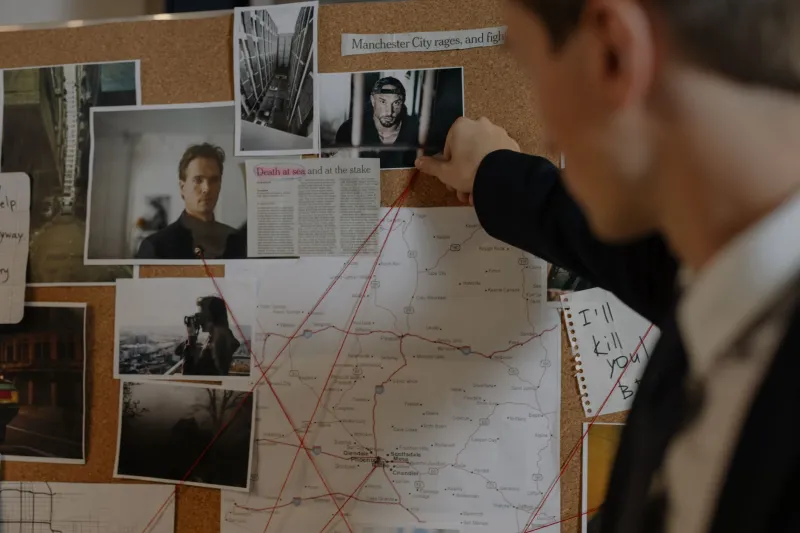
There is a subreddit where 14,000 people have spent the better part of two years investigating a mystery that one person made up on a Tuesday afternoon. The investigation has produced spreadsheets, timelines, a 90-minute YouTube documentary, and at least two genuine friendships. The mystery is completely fictional. The community is entirely real.
This is the conspiracy hobby era — and it has nothing to do with believing anything. It has everything to do with doing something together.
The Setup
Alternate reality games, or ARGs, have existed since the early internet — elaborate narrative puzzles distributed across websites, phone numbers, cryptic images, and buried HTML source code that players collectively decode. The form has a legitimate history: I Love Bees, the ARG used to market Halo 2 in 2004, drew hundreds of thousands of participants. The Beast, Microsoft's campaign for the film A.I., is considered a foundational text of the form.
But something has shifted in recent years. The ARG format has metastasized beyond its original promotional function and into something stranger and more interesting: communities that build their own fictional mysteries from scratch, often without any central authority coordinating them, and then proceed to investigate those mysteries with a rigor that would make an actual detective nervous.
The mystery doesn't need to be "real" in any meaningful sense. It just needs to be there.
The Anatomy of a Fake Investigation
Here's how it typically goes. Someone posts something — a cryptic image, an "unexplained" series of events, a Reddit post formatted to look like a genuine plea for help that contains just enough detail to be tantalizing and just enough vagueness to be infinitely interpretable. Within hours, a thread has formed. Within days, someone has made a Google Doc. Within weeks, there are competing theories, designated researchers, people who have taken on specific investigative roles like "timeline keeper" or "image analysis lead."
The community develops its own internal culture at remarkable speed. In-jokes emerge from the investigation itself. Certain theories become associated with their proponents and get defended with genuine passion. There are moments of collective breakthrough — when a piece of "evidence" clicks into place — that generate the kind of shared excitement you might associate with a sports team scoring in overtime, except the sport is collaborative fiction and everyone knows it.
Except, sometimes, not everyone knows it. Which is where things get genuinely interesting.
The Blurred Edge
One of the defining features of the best fake investigations is the deliberate maintenance of what researchers call "the magic circle" — the shared agreement to treat the fiction as real within the context of the game, even while knowing, on some level, that it isn't. This is not a new concept; it's the same mechanism that lets you cry at a movie you know is scripted. But in collaborative online investigation, the magic circle can develop some genuinely permeable edges.
People have reported feeling genuine anxiety about fictional mysteries they're "solving." Communities have had to establish explicit "reality check" protocols to help members who've gotten too deep reorient themselves. There's documented evidence of participants in extended ARGs developing what researchers describe as "lore brain" — a state where the internal logic of the fictional world starts to feel more immediately present than the actual world.
This sounds alarming, and sometimes it is. But it also points to something important about why these fake investigations work so well as a form of entertainment: they engage the brain's threat-response and pattern-recognition systems in a way that passive consumption simply cannot. You are not watching someone solve a mystery. You are in the solving. Your nervous system doesn't fully distinguish between those two experiences.
The Collaborative Cognition High
Cognitive scientists have a term for the mental state that emerges when a group of people thinks together effectively: transactive memory. It's the phenomenon where a group functions as a single distributed intelligence, with different members holding different pieces of knowledge that combine into something greater than any individual could produce. Good teams experience it. Long-term couples experience it. And, it turns out, fake detective communities experience it in concentrated, almost intoxicating bursts.
When a 200-person Discord server cracks a cipher that one of their members embedded in an image three weeks ago, the collective euphoria is real and neurologically meaningful. The brain releases the same reward chemicals whether the mystery was real or invented. The satisfaction of pattern completion is not contingent on the pattern's ontological status.
In other words: the mystery being fake does not make the solving feel fake. It just makes it safe.
Safer Than the News, More Fun Than Netflix
There's a reason this hobby has exploded in an era defined by information overload, genuine geopolitical chaos, and a news cycle that presents real mysteries with no satisfying resolutions. Actual conspiracies — the ones that matter, the ones with real stakes and real victims — tend not to resolve cleanly. They sprawl. They implicate systems too large to feel actionable. They produce not the dopamine hit of "I figured it out" but the grinding anxiety of "nobody is figuring this out."
Fake mysteries are engineered to resolve. Even the most sprawling, elaborate ARG has an author somewhere who knows the answer. The investigation has a shape, even if the participants can't see it yet. There is, somewhere, a bottom to the rabbit hole.
That guarantee of resolution — of a mystery that will, eventually, make sense — is a form of narrative mercy that the real world simply cannot offer.
The Community Was Always the Point
Ask veterans of long-running fake investigations what they remember most, and they almost never talk about the mystery itself. They talk about the people. The friend they made while arguing about a piece of "evidence" that turned out to be a red herring. The Discord voice calls at 1 a.m. when a breakthrough happened. The inside jokes that only make sense if you were there for the third week, when everyone was convinced the answer was hidden in a particular font choice.
The fiction was the container. The community was the content.
Which is, when you think about it, exactly what the best entertainment has always been — not the thing itself, but the people you experienced it with. Fake mysteries have just figured out how to make you do the experiencing together, in real time, with stakes that feel genuine even when everyone knows they aren't.
The case was never real. The connection always was.